

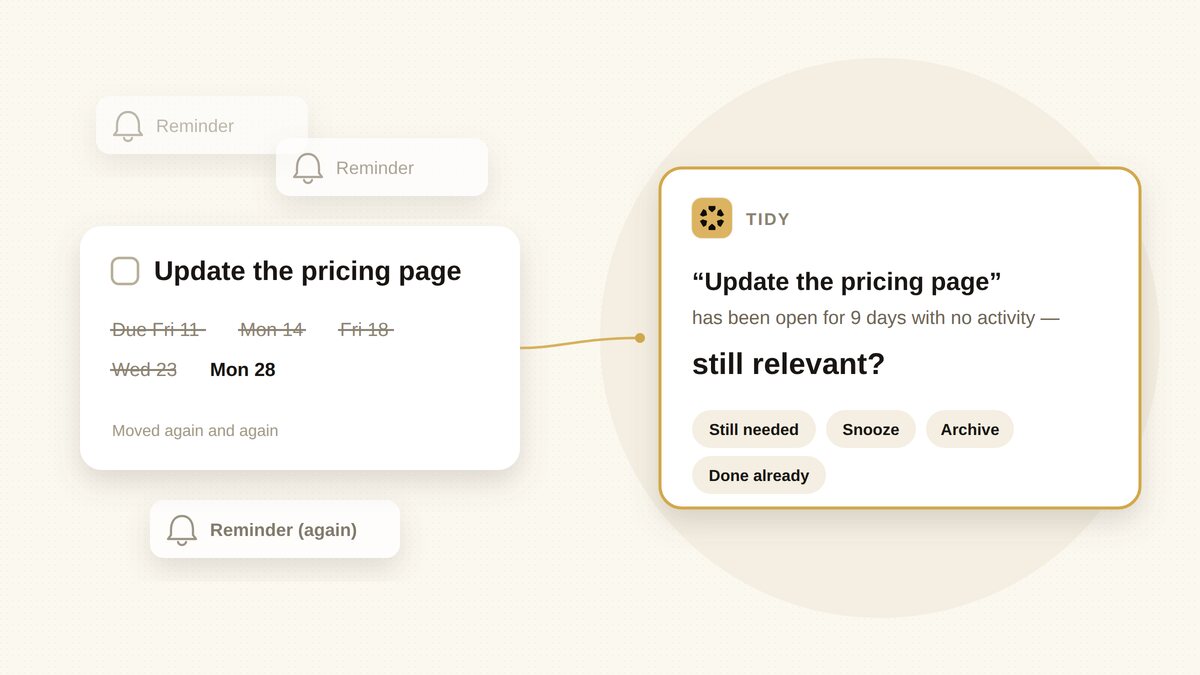
There’s a to-do on your list that you’ve moved five times. Each time you see it, it costs a little. Not much, just enough. So you set a reminder. Then a louder one. Then you move it again, and now it costs a little more.
Publisher disclosure: we build Sharick. One section near the end describes a change we made to Sharick’s own daily briefing. Everything else works with paper, a spreadsheet or any to-do app. The examples are illustrative.
The to-do you’ve moved five times
A reminder answers one question: when. But a to-do you keep moving isn’t confused about when. Every time you look at it, it’s asking something else: whether. Whether it’s still yours. Whether it’s for now. Whether you’re ready to face what it leads to.
That’s why pushing harder rarely works. A louder reminder answers a question nobody asked, and the real one goes on waiting under it. The useful move is to stop pushing and ask.
A reminder asks “when?” A to-do you keep moving is asking “whether?”
Three ways to read a postponed to-do
Most to-dos that keep slipping fall into one of three readings. They describe the task, not you.
- It isn’t yours anymore. The plan changed, someone else picked it up, or it was never yours to begin with. The honest move is to hand it back, pass it on, or let it go.
- It isn’t for now. It matters, just not this month. A date you keep moving isn’t a plan. It’s a small alarm you’ve learned to ignore. Give it a real later date, or no date at all, and stop paying for it every morning.
- It’s hard because it matters. The next step means facing something: a pricing conversation, a hard message to a cofounder, finding out whether anyone actually wants the thing. This one won’t go away when you move it, and it won’t get easier with a reminder.
The first two are cleanup. The third is the reason to do the cleanup.
One question, four honest answers
Instead of a new date, give the to-do one question: is this still wanted? Then pick an answer. Every one of them is a good answer.
| Answer | What it means |
|---|---|
| Still needed | It’s yours and it’s for now. Give it a date you intend to keep, a week out, not a hopeful tomorrow. |
| Snooze | It matters, just not now. Pick a real later date and let it rest until then. |
| Archive | Out of view, not deleted, not a failure. You can always bring it back. |
| Done already | More common than you’d think. It got handled somewhere else and the list never heard. |
Bigger goals get a slightly different set: recommit with a new target, close it, or call it not relevant anymore. Closing a goal you’ve outgrown isn’t giving up. It’s a decision, and it’s yours.
Do it by hand, once a week
You don’t need a tool for this. You need fifteen minutes and a rule.
- Pick a slot. Friday afternoon works for many people: the week is ending, and nothing new is likely to land.
- List everything a week or more past its date. Not everything overdue, just the ones that have had a full week to happen and didn’t.
- Give each one an answer from the table. One at a time. No skipping, and no new date without picking an answer first.
- Stop when the time is up. Whatever’s left waits for next week. This is meant to make the list lighter, not to become another chore.
As you go, notice which items you can’t answer quickly. That pause is information. It usually means you’ve found the third kind.
For the hard one: write the question, not the task
A to-do that’s hard because it matters is rarely a task at all. It’s a question wearing a task’s clothes. “Update the pricing page” might really be “Will anyone pay for the team plan?” “Write to Alex” might really be “Are we still building the same company?”
For that one item, once a week, write four short lines:
- The question. One sentence, in your own words.
- Your answer right now. Even if it’s a guess.
- How sure you are. A number from 0 to 100%.
- What would move that number. One thing you could see or hear this week, and one small step to go and look.
Why write down how sure you are, not just the answer? Because it turns a belief into a hypothesis that’s allowed to move. You don’t need to be certain to take one small look. And next Friday, you don’t ask yourself, “Did I do the task?” You ask, “Did the number move, and what moved it?” That question is much easier to come back to.
What we changed in our own briefing

We learned this the uncomfortable way. Until late September, Sharick’s daily briefing did exactly what this article argues against. It took a to-do that had been open for five months, presented it as today’s risk, and gave it a same-day deadline. A real to-do, pushed the wrong way.
We rewrote it. Now, when a to-do in one of your topics is a week or more past its date, the briefing doesn’t rank it or press it. It asks:
“Pitch deck v2” has been open for 9 days with no activity — still relevant?
- The same four answers, listed next to the question. Still needed, snooze, archive, or done already. Goals that have slipped past their target get recommit, close, or not relevant. For now you act on the answer yourself: change the date, archive it, or mark it done.
- A few questions, not a wall. At most three in a briefing, under a short “Tidy” heading.
- Kept out of the urgent parts. It’s filtered out of the day’s risks and its one decision, and the briefing is told not to make it urgent or the top line.
- It lets go. Each to-do is asked about at most twice. After that, Sharick stops asking.
It’s a small change, and it isn’t finished. But it came from the same belief as this article: an assistant should help you see your list clearly, not push you through it.
What this is not
- Not a daily score. For a list you tidy by hand, once a week is enough. Asking yourself every day turns a question back into pressure.
- Not a way to get more done. Most of the time the list should get shorter. That’s the point.
- Not something to carry alone. If the hard question feels too heavy to write down, say it out loud to someone you trust first.
A shorter list is one you can believe. When what’s left on it is really yours and really for now, you stop paying for the rest every morning. And the one question that matters gets the attention it’s been waiting for.
This week, write one line: the question underneath the to-do you’ve moved the most.
Sources and limitations
- The three readings, the weekly practice and the four-line note are suggestions from our team, not a clinical method. The examples are illustrative.
- The description of Sharick’s briefing reflects the product as of October 6, 2026, following a change we shipped on September 28, 2026. Thresholds and wording may change.