

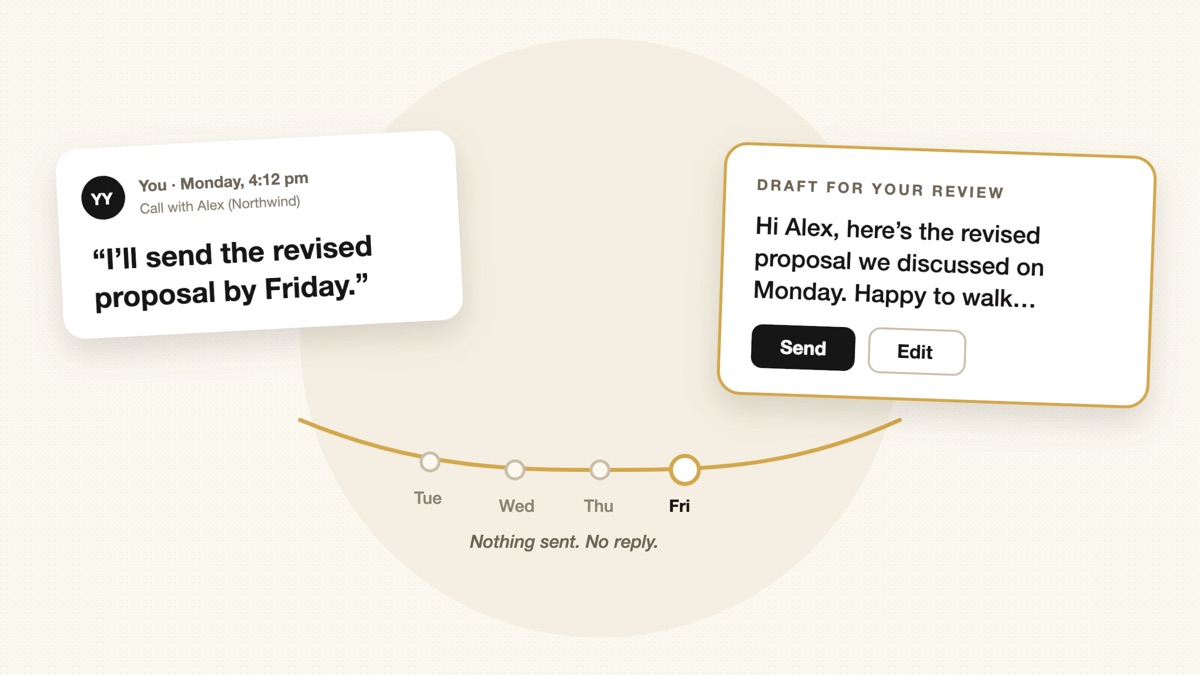
“I will send that over tomorrow.” “Let me check with the team and get back to you.” Sentences like these create real obligations, and almost none of them get typed into a task manager. They live in email threads, meeting notes, and chat, and they slip quietly.
Why follow-ups slip
Follow-ups fail for three ordinary reasons:
- They are never captured. The promise is spoken or typed in passing, so it never reaches a list.
- They point in two directions. Some you owe. Others you are waiting on. Most tools only handle the first.
- They go stale. The other person replies in a different channel, the plan changes, and the reminder fires anyway.
A reminder app solves none of these, because each one requires reading the context. That is why this job suits an AI assistant.
What a follow-up assistant should track
| Field | Why it matters |
|---|---|
| Source | You need to see the original message or meeting to trust the nudge. |
| Direction | “I owe them” and “they owe me” need different actions. |
| Owner | In group threads, the promise often belongs to someone else. |
| Expected date | Stated or implied. “Tomorrow” said on Friday means Monday. |
| Latest status | A reply anywhere should close the loop, not just in the original thread. |
If a tool cannot show you these for a given reminder, you will end up checking everything yourself, and the assistant becomes one more inbox.
When it should nudge, and when it should not
Good timing is most of the value. A follow-up nudge is worth it when:
- The expected date has passed and nothing has happened since.
- You are about to meet the person, so it is the natural moment.
- Something you are waiting on is blocking something you owe.
It should stay quiet when the loop closed somewhere else, when you already snoozed it for a reason, or when the item is low stakes and you have said so. An assistant that nudges for everything trains you to ignore it. We think this restraint deserves its own name; more in the case for attentive AI assistants.
Drafting vs sending
Some assistants will send follow-ups automatically. That can be fine for low-risk, repeatable messages you have explicitly set up. For anything involving a relationship, a draft you approve is the safer default: tone and timing are judgment calls, and one wrong automated message can cost more than the follow-up saves.
How Sharick approaches it
Sharick picks up commitments from your meetings and messages, keeps each one linked to its source, and brings the open ones into your daily briefing. You can correct an owner or a date, and actions that affect other people wait for your approval. It is one approach among several; for alternatives, see our comparison of proactive AI assistants, or read about proactive vs reactive assistants if you are still deciding whether you need one.