

This essay was first published on X on September 29, 2026. It is republished here with light edits.
A year ago, the question was “can AI do this?”
Now it usually can. Claude writes the PR. Codex runs the refactor. An agent drafts the email, summarizes the meeting and preps the brief. Overnight jobs finish before you wake up.
So why does the day still feel slower than it should?
Because every one of those agents ends the same way: it comes back to you.
“PR ready for review.” “Draft ready, send?” “I found two options, which one?” “Blocked: need your API key.” “Meeting notes attached, 3 action items.”
We scaled the workers. We didn’t scale the person they all report to.
The gridlock
Think of a city where every car got faster overnight. Traffic doesn’t improve. Every car now reaches the same intersection sooner, and the intersection is you.
That’s what running five or ten AI agents in parallel feels like:
- Everything pings you at once. Each agent is polite and reasonable on its own. Together they’re a denial-of-service attack on your focus.
- Nothing tells you what matters. A finished draft for a low-stakes blog post and a blocker on a customer deal arrive with the same urgency, in the same format.
- Context switching compounds. Every handback asks you to reload a mental model: what was this, why did I start it, what did I decide last time?
- Things get lost quietly. The agent finished. You saw the notification. You meant to review it. Three days later the PR is stale and the customer email was never sent.
The output from AI keeps growing. Your brain’s capacity (attention, working memory, decision energy) stays the same, and it may shrink as the load grows. That gap is the new bottleneck.
More AI won’t fix this by itself
The obvious answer is “let the AI decide more.” Sometimes that’s right. But most of what comes back to you comes back because it should: taste, trust, relationships, money, direction. Those are the decisions you shouldn’t hand off.
So the goal isn’t to remove you from the loop. It’s to protect the loop, so that the few moments that need you get your full attention and everything else stays out of the way.
What’s needed: an Attentive Dispatcher
In emergency response, callers don’t all ring the fire chief. A dispatcher sits in between. They listen to everything, work out what each call is, send routine calls where they need to go, and bring the chief only what needs the chief.
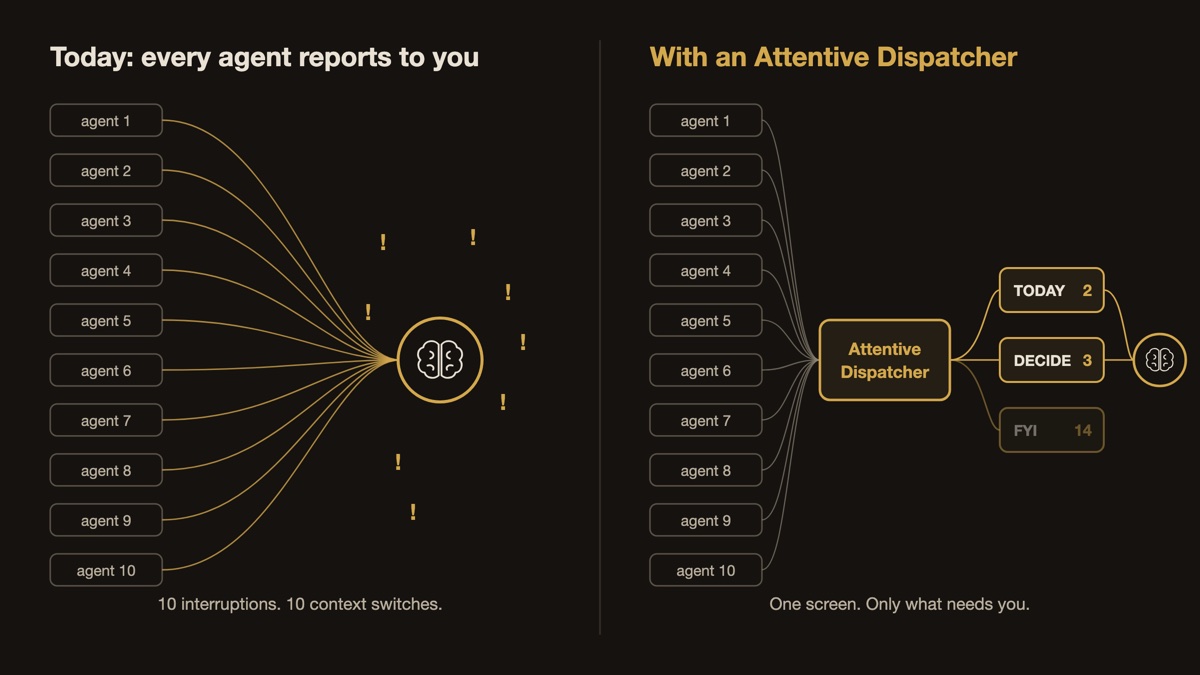
Knowledge work with AI needs the same role. An Attentive Dispatcher:
- Holds all the context, so you don’t have to. It knows why each task exists, who asked for it, what you decided last week and what’s waiting on whom.
- Triages by what matters, not by what arrived first. Needs you today. Needs a decision. Just so you know. Three buckets on one screen, not a feed.
- Batches the interruptions. Five small approvals become one pass over coffee instead of five context switches spread across the afternoon.
- Notices silence. The agent that never reported back, the reply that never came, the promise made in a meeting that nobody logged. Gridlock also shows up as the things that quietly stopped.
- Closes the loop. When you decide, the decision goes back out to the right agent or person, with the context attached.
The key word is attentive. A plain router forwards messages. An attentive dispatcher understands them. It knows the difference between “done” and “done, but I guessed on something important.” (We wrote more about that difference in the case for attentive AI assistants.)
The new unit of productivity
For a long time we measured productivity by output. With AI, output is cheap and close to unlimited.
The scarce thing now is decisions per unit of brainpower. How much good judgment can you apply per hour without burning out or dropping things?
The people and teams who pull ahead won’t be the ones running the most agents. They’ll be the ones whose agents don’t turn into a traffic jam in their head.
Why we’re building Sharick
This is the problem we’re building Sharick to solve. It’s an AI chief of staff that sits between you and everything competing for your attention: your AI agents, email, chat, meetings and todos.
It captures what’s happening, keeps track of commitments and context, and brings you a short briefing: what needs you today, what needs a decision, and what you can safely ignore. When you decide, it routes the decision back out.
Your AI can already do the work. Sharick makes sure your brain isn’t the thing slowing it down.