

This essay was first published on X on October 1, 2026. It is republished here with light edits.
This week Brian Chesky told TechCrunch that AI agents need their own operating system. Today we build AI apps on top of iOS, macOS and Windows, systems designed for apps a person opens, not for agents that work on their own. He wants an SDK, interoperability standards like MCP, and much richer interfaces. "All apps need to become agents," he said.
From where Airbnb sits, that's exactly right. If you build an app, you need a way for agents to use it, talk to other apps through it, and show people more than a chat box. That's the outer layer of an operating system, the interfaces and drivers that let software plug in. Chesky is describing it well, and someone has to build it.
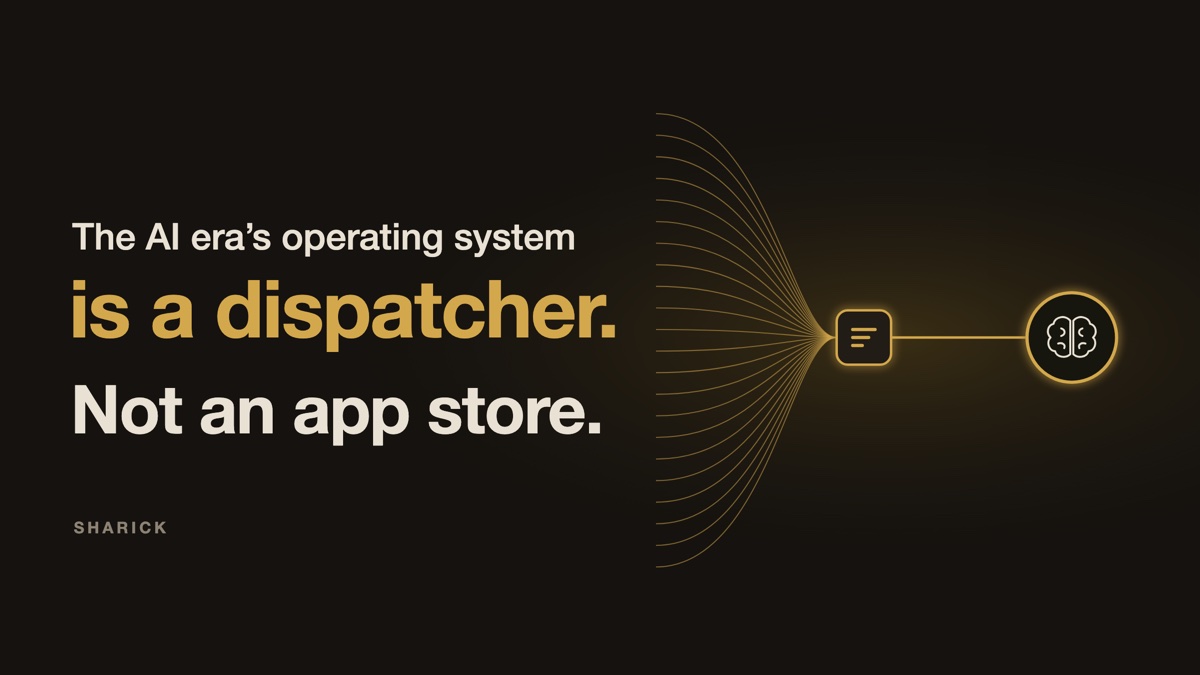
But an operating system has a center too, the kernel. And I think the kernel is where the real change is happening this year.
Today, AI sits behind you
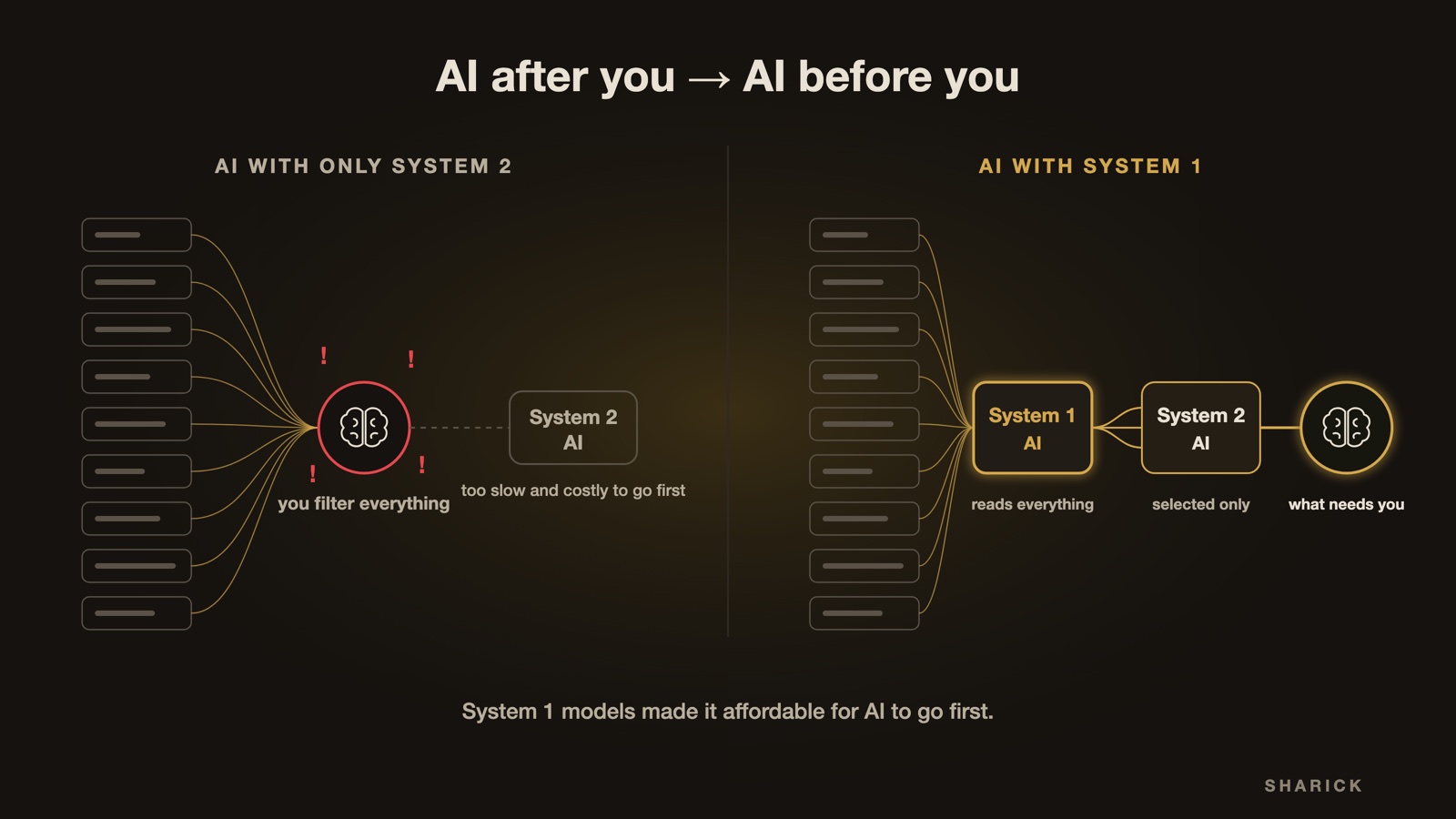
Look at how almost every AI product works today. You go first.
You read the email, then ask AI to draft a reply. You notice the PR is waiting, then ask AI to review it. You remember the promise from Tuesday, then ask AI to write the follow-up. Even agents that run on their own end the same way. They finish, then come back and wait for you.
AI sits after you. You are the filter, the router and the gatekeeper for everything it touches. So as AI gets faster and more capable, the queue in front of you only grows. I wrote about this last week in AI isn't the bottleneck anymore. Your brain is.
The fix seems obvious. Put AI in front of you, let it read everything first, and hand you only what needs you.
So why hasn't anyone done it?
The economics just flipped
Because until a few weeks ago, the math didn't work.
To sit in front of you, AI has to look at everything. Every message, every email, every meeting, every agent's update. Hundreds or thousands of events a day, most of them unimportant. With only large, general models available, each look cost real money and took seconds. You'd pay a lot, wait a lot, and most of what you paid for would be a model concluding "this one doesn't matter."
Cost times latency was higher than the return. So AI stayed behind us, called only after a human had already decided something was worth it. Nobody chose that design. It was the only arrangement the economics allowed.
That changed in the last few weeks, when a wave of System 1 models arrived, built for exactly this job.
- Jev by TypeSafe AI (September 15). TypeSafe coined the term "System One model." Instead of generating text token by token, Jev takes messy state and returns typed decisions with calibrated probabilities. TypeSafe reports 70 to 500 milliseconds per decision, and up to hundreds of times cheaper than frontier models on decision-shaped questions.
- OpenAI's Decisions API (DevDay, September 29). You define a question with a fixed set of answers (route this, classify that, pick the next move) and get a decision with a probability in about 150 milliseconds, instead of the 1.6 seconds a normal call takes. It's in limited preview.
- Perplexity's Decisions API. You send content and named questions (yes or no, a choice, or a score) and get probabilities back instead of text. Output tokens are free, and input costs four cents per million tokens.
- Clef by Cloudflare. It's open weight under Apache 2.0 and free to run yourself. It turns a state and a schema of typed questions into decisions with no free-form text at all, in about 209 milliseconds at the median and under 40 for its Flash variant.
Four very different companies made the same bet within a few weeks. The next important model isn't the one that writes the best essay. It's the one that decides fastest what deserves the essay.
That's the flip. Looking at everything is now fast enough and cheap enough that the return wins. For the first time, it makes economic sense to put AI before you instead of after you.
That changes the stage. Not because models got smarter, but because a new kind of model made a different arrangement affordable.
What a kernel actually does
Once AI can sit in front of you, the question becomes what it should do there. Operating systems answered that decades ago.
Strip an OS down to its kernel, and its job is surprisingly narrow.
- Scheduling. Many processes want the CPU, and the kernel decides who runs and when.
- Interrupts. When something happens, the kernel decides whether to stop everything and deal with it now, or later.
- Memory and protection. It keeps track of state and stops one process from trampling another.
SDKs, drivers and app stores all sit around this core. They matter, but they aren't what makes the machine usable. The kernel is dispatch, a constant, fast stream of tiny decisions about what deserves the one scarce resource.
The scarce resource is you
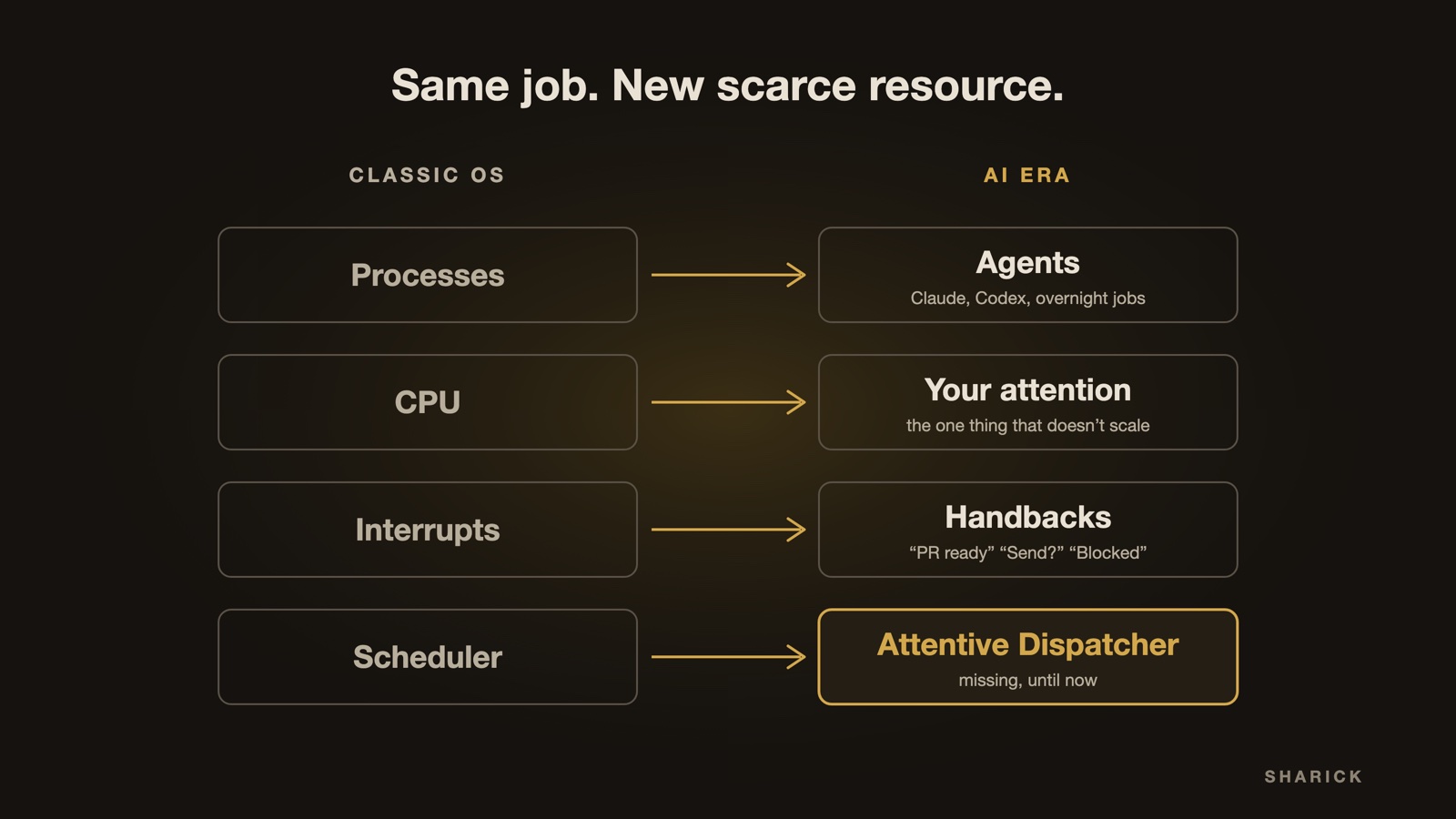
For forty years, the scarce resource was the CPU. Now compute is abundant. You can run ten agents in parallel, overnight, for less than a coffee. What isn't abundant is your attention.
The mapping is almost exact.
- Your agents are processes.
- Your attention is the CPU.
- Every "PR ready for review," "Draft ready, send?" or "Blocked, need your key" is an interrupt.
- And today there's no scheduler. Every interrupt goes straight to you, in arrival order, at full priority.
The OS the AI era is missing is the one that schedules your attention. Until System 1 models, it couldn't be built, because a scheduler has to look at every interrupt.
Why the big models couldn't be the kernel
A kernel handles every interrupt, constantly, in milliseconds. You don't run a kernel on your slowest, most expensive processor. Large reasoning models are brilliant and slow, with seconds per decision and real cost per call. Route every event through them and you've built a very expensive way to be late.
Psychology has a name for this split. In Thinking, Fast and Slow, Daniel Kahneman described two modes of thinking.
- System 1 is fast, automatic and cheap. It notices a face, reads a room, and flags that something's off without being asked.
- System 2 is slow, deliberate and effortful. It does the math and writes the careful reply.
Your brain doesn't run System 2 on everything. System 1 filters the whole world continuously and escalates only what needs deliberate thought. That's not a limitation. It's the architecture that makes thinking possible at all.
Until this year, AI only had System 2. Now it has both.
What an AI-era OS looks like
- A System 1 layer in front of everything. Fast, cheap and always on, it reads each event as it arrives, routes routine work to the right agent, and notices silence, like the reply that never came or the job that stopped reporting.
- A System 2 layer called only when needed. The big models still draft, reason and plan, but only for what System 1 selected.
- You, called only for what needs you. Direction, relationships, money and taste, batched with context attached, on one screen.
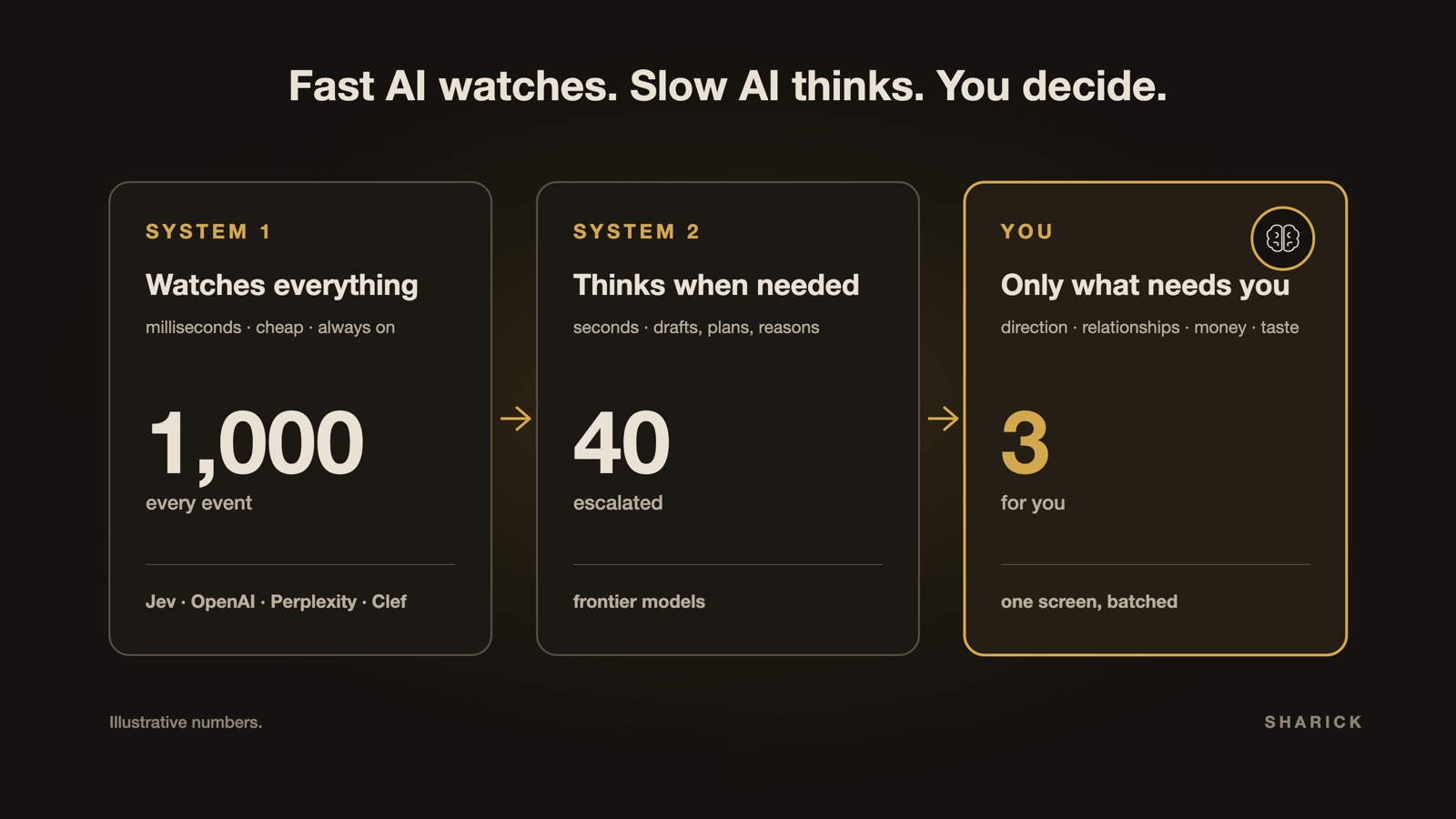
That's a dispatcher. And a good dispatcher doesn't just forward, it understands. It knows the difference between "done" and "done, but I guessed on something important." That's what I mean by an attentive dispatcher.
The outer layer still matters
None of this works without what Chesky is describing. Agents need standard ways to talk to each other and to your tools, and MCP is a real step. In OS terms, that's the interface and driver layer, essential and worth getting right.
But a great outer layer with no kernel just means every connected app can interrupt you at once. Interoperability makes the traffic possible. Dispatch makes it bearable.
An app store decides which apps reach you. A dispatcher decides which moments reach you. The second is the harder problem, and the one that changes how a day feels.
What we're building
This is the idea behind Sharick. It sits in front of you, between you and everything competing for your attention, including your AI agents, email across accounts, chats across apps, meetings and todos. A fast layer reads all of it as it arrives and decides what each item is. It keeps the context, catches what you promised and who you're waiting on, and notices what went quiet. Heavier models come in for drafts and decisions. And you get one short briefing with what needs you today, what needs a decision, and what can wait.
It proposes. You decide. Nothing goes out under your name without you.
The next OS
For years, AI had to wait behind us, because going first cost more than it was worth. That's over.
Chesky is right that apps need a new outer layer to become agents. The App Store won the last era by deciding which software reaches you. The next operating system wins at the center, by deciding which moments deserve you. Fast AI in front of everything, slow AI that thinks when it matters, and a person who's only interrupted for what only they can do.
That's the OS I want. We're building it.